

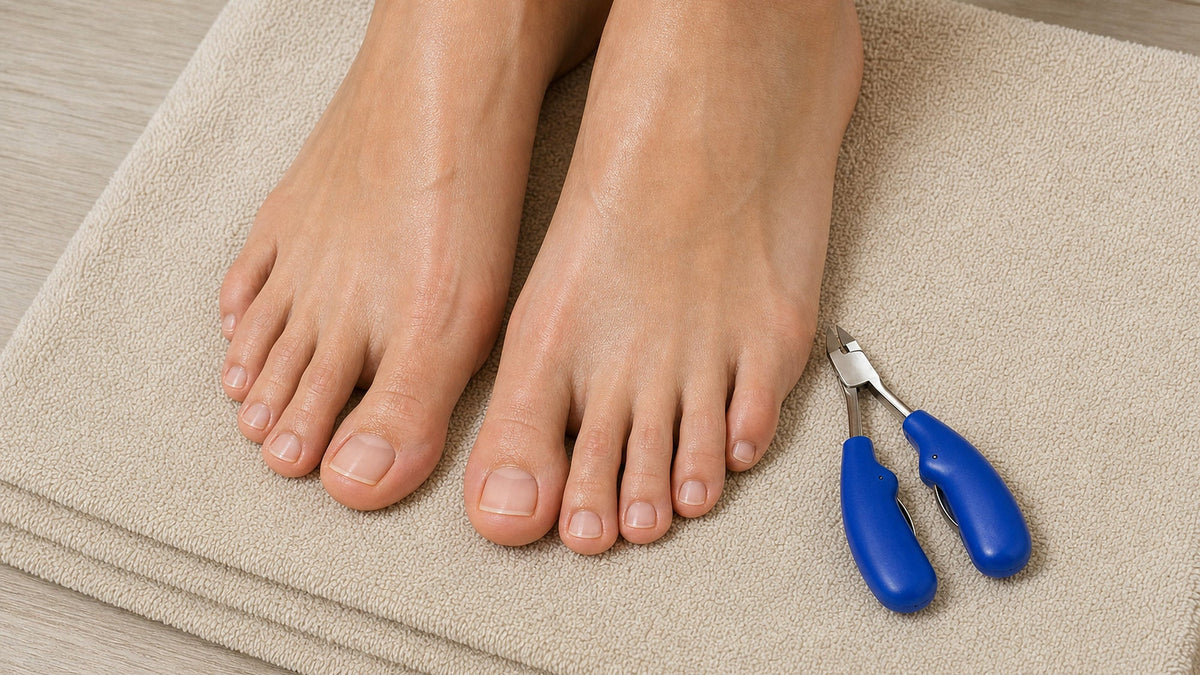
Sound familiar? The sock catches on a corner, the shoe presses on the big toe, and the next time you look you think: somehow the nail isn't sitting right anymore. Often there's less bad luck behind it than a small habit. If you cut toenails rounded, make them too short or crush them with a blunt tool, you give the nail a direction it shouldn't have.
In this post we show you the cutting technique that counts as the golden rule in foot care: straight, not rounded. You'll find out which clipper fits which nail, how to care for cuticles and corners gently, and when it's better to see a professional foot-care specialist. No diagnosis, just a clear guide for everyday life.
Why nails grow in at all
A nail doesn't simply grow into the skin. It follows the path that pressure, shape and the cut give it. If the front edge is cut rounded, the side corners that keep the nail in its track are often missing. Then it can run sideways into the nail fold, especially on the big toe.
Tight, pointed shoes, socks with a hard cuff or sport in which the foot slides forward in the shoe also play a part. Very thick, dry or strongly curved nails and a family tendency can play a role too. That doesn't mean you're powerless, because technique and footwear count more than the next radical cut.
Important beforehand: this post is no substitute for medical advice. If the toe is already red, hot, swollen or painful, if pus is visible or the nail is sitting deep in the skin, that is nothing for the clippers at home. Then the foot belongs in professional hands, in medical foot care or a doctor's practice. That applies especially if you have diabetes or circulation problems. For that we already have the post Diabetic Foot Care.
The golden rule: straight, not rounded
You cut toenails straight, not rounded and not pointed. Picture the front edge as a narrow, calm bar: from one corner to the other, without taking the corners out deeply. A very slight, natural following of the nail's width is fine. A semicircle like a fingernail, though, is something you should avoid.
Two things often get mixed up here, so a short clarification. “Cut straight” means the shape of the nail edge you leave behind. Many good toenail clippers still have a slightly curved or concave cutting edge. That follows the natural curve of the nail across the width of the toe, so the cut sits cleanly and doesn't crush. The tool may therefore be curved. The edge of the nail should still stay straight.
Don't cut too short, either. A narrow, visible rim above the skin is better than a nail that ends with the tip of the toe or disappears underneath it. Nails cut too short give the shoe direct pressure on the nail fold, and that's often exactly where the trouble starts. Don't tear corners off and don't nip into the side fold.

How to get ready for cutting
Give yourself ten quiet minutes, good light and a position in which you can really see the toe. On a stool or at the edge of the bed, the foot on the opposite knee or firmly on the floor, whichever is comfortable for you. Rushing is a poor adviser, especially on the big toe.
The tool should be clean, dry and sharp. A blunt clipper crushes the nail, leaves frayed edges and irritates the skin beside it. After use, wipe the clipper, store it dry and disinfect it if needed. A kitchen scissors or a small fingernail clipper is not suitable for thick toenails.
If the nails are very hard, you cut them more easily once they are a little more yielding, for example after a shower. That way the nail stays less brittle, and the clipper cuts instead of crushing.
The cutting technique, step by step
Work nail by nail, ideally from the big toe to the small ones. You want a controlled line, not a mosaic of little bites that ends up wavy.
- Set the direction: Look at the natural width of the nail. The cutting edge should run parallel to the skin in front of the nail, not in an arc down towards the corners.
- Position it safely: Open the clipper wide enough, guide the cutting edge under the free nail edge and make sure no skin is in the cutters. Hold the toe still with the other hand.
- Shorten in one or a few calm cuts: On a nail that is not too wide, often in one go. On a very wide or thick nail, better in two or three clear steps from one side to the other, but always in the same straight line. Don't twist or tear as you do it.
- Leave the corners: The side corners may stay visible, slightly above the nail fold. You don't round them and you don't file them into the fold.
- Check the edge: Stroke the edge with your finger. A sharp burr you may smooth very carefully. The straight shape stays.
If a nail splits or the clipper jams, the tool is usually too blunt or the nail too dry. Then it's better to pause than to tear onwards.

Which clipper fits which nail
A good toenail clipper takes the effort off you and guides the cut, instead of crushing the nail. Our three toenail clippers differ mainly in handle, length, spring and cutting-edge shape. All have a cutting edge that follows the toe's radius, and all are made of stainless steel.
The Pro Toenail Clipper is the uncomplicated everyday choice, especially if you don't want to use much force. The ergonomic plastic handles sit calmly in the hand, the double spring that folds out to either side makes it usable for right- and left-handers, and the curved stainless-steel cutting edge follows the toe. It also copes well with thick or hard nails. If you're looking for a clipper that opens easily and sits well in either hand, this is a sensible place to start.
The Toenail Clipper Turn Bull is, at 14 cm, the longest of the three and gives you more leverage and a stable grip. It also has a curved stainless-steel cutting edge and is designed especially for thick and hard toenails. The built-in spiral spring opens the clipper by itself after every cut, and a catch on the handles keeps it closed when you put it away.
The Toenail Clipper Head Cutter is more compact at 11.5 cm and is meant for spots you can't easily reach with a straight-guided clipper. The angled cutting head brings the edge into a better position, the concave cutting edge follows the toe's radius, and the pointed ends also let you use it as a corner clipper. That means: carefully tidy the edge, not clear out the fold or cut a corner deep out of the nail. It is also suitable for the hands; in this post it remains the tool for hard-to-reach toes and fine edges.
In short: little effort and everyday use lead to the Pro Toenail Clipper, thick and hard nails to the Turn Bull clipper, difficult angles and precise corners to the Head Cutter. You don't have to own all three. Look at where it sticks for you: at the force, at the thickness or at the access.

Caring for cuticles and corners gently
Besides the cut, the edge often decides whether a nail will press later. Dry cuticles or small flakes of skin in the corner tempt you to tear or poke. That irritates the fold. Better is: keep them soft, push them back gently, don't cut anything living.
The Cuticle Pusher Double is built for that. It has two identical, flat ends with which you gently push the cuticle back at the base of the nail. Thanks to the ridged handle it sits securely in the hand even with damp hands, and because it is made of stainless steel, you can clean it hygienically. You push the cuticle back flat and with little pressure, not down into the nail and not with the tip into the fold.
If you want to remove the cuticle regularly, it helps to soften it first. The Active Solution No. 1 is a good fit for that, or, if you prefer a somewhat gentler start, the Active Solution No. 4. Apply the solution in a targeted way, let it work in briefly and only then work gently with the pusher. This regular care at the nail edge can also help support the prevention of ingrown nails. A practical tip for this: put a little Vaseline or a rich cream on the nail beforehand. That helps prevent possible short-term discoloration and is quickly done.
If the cuticle is only sitting a little dry and tight and you don't want to reach for the solution straight away, a nourishing cream is often enough, or working after washing, while the skin is still supple. Never pull on torn or inflamed skin and never cut cuticles just because they are in the way. What doesn't move easily, you wait out or, if it looks inflamed, have a podiatrist take a look.
The same calm applies at the corners. A corner that stands out slightly is not a mistake, but often exactly the protection the nail needs. Only if a fine, dry burr keeps catching on the sock may you carefully tidy it straight with a suitable clipper, for example the Head Cutter. If the corner is already in the skin or the toe hurts, better leave it and go to medical foot care.

Afterwards: shoes, socks and a little care
The best cut only lasts if the shoe plays along. So what matters is enough room at the front of the shoe and socks without thick seams over the nails. In sport or on longer hikes, a lacing that holds the foot back also helps, so it doesn't slide into the toe box.
After cutting, cream the skin around the nail lightly, so the fold doesn't dry out and tear. You don't have to bury the nail itself under a thick layer.
How often you cut depends on the growth. Many people get on well every one to two weeks. A good moment is when the nail starts to catch on the sock, not only once it is already growing around the corner. Better regularly a little than rarely and then too radically.
When you'd rather go to a professional
There is a clear line between care and treatment. Get professional help if one of these points applies:
- The toe is red, hot, swollen or throbbing.
- Fluid or pus is coming out, or the nail is clearly sitting in the skin.
- You have strong pain when walking or even at rest.
- The nail is very thick, strongly deformed or keeps breaking in.
- You have diabetes, neuropathy or circulation problems. Then special care is needed, even with small cracks.
In these cases your own clipper is the wrong instrument. Medical foot care or a doctor's practice can relieve the nail properly. Cutting away another little piece often makes the problem bigger.
Frequently asked questions
May I still make toenails a little rounded so they look nicer?
Better not, especially not on the big toe. A nice nail is one that doesn't hurt. A straight edge that is not too short grows more reliably.
What about the corners? Do I have to cut them free so nothing grows in?
No. The corners should stay and guide the nail. Cutting them free in the fold is one of the typical paths into the problem you want to avoid.
Can I use the same clipper for hands and feet?
The Head Cutter is also suitable for the hands. For thick toenails you still need a real toenail clipper with enough force and a fitting cutting edge. A small fingernail clipper is usually too weak for toenails.
How do I tell that the clipper is no longer up to it?
If it jams, crushes the nail, leaves frayed edges or you need noticeably more force than before, it is blunt or twisted. Then it's better to replace it than to push harder.
In short: cut straight, use the right tool, stay calm
Ingrown nails are rarely a fate that simply comes over you. Usually it is the combination of a rounded cut, an edge that is too short, a tight shoe and a tool that crushes the nail more than it cuts. The counter-strategy is unspectacular and that's why it works so well: shorten straight, leave the corners, choose a clipper that fits your nails, and only push cuticles, never tear them.
Your short plan:
- good light and a calm posture
- a sharp, clean clipper
- cut a straight line, leave the corners
- check the edge
- gently push the cuticle
- check shoes and socks
If there is inflammation, diabetes or a nail that is already ingrown, go straight to a professional.
By the way
You'll find the tools from this post in our shop, developed in Cologne, as a Cologne original since 2002:
- Pro Toenail Clipper - Stainless Steel, Plastic Handle, Double Spring: everyday use and little effort, for right- and left-handers
- Mr. Fuss Toenail Clipper Turn Bull with spiral spring - 14cm: longer handle, spiral spring, especially for thick, hard nails
- Mr. Fuss - Toenail Clipper Head Cutter - 11.5 cm: angled head and pointed ends for hard-to-reach edges
- Cuticle Pusher Double: two identical, flat ends for gently pushing back the cuticle
Note: This post is no substitute for medical advice or medical foot care. If you have diabetes or circulation problems, your skin is injured or a nail looks inflamed or badly ingrown, please get professional advice before you cut yourself or use instruments. If pain, swelling or skin changes persist, please have them examined.



Share:
What your calluses reveal about you: the foot map for a self-check